Scaffolding Licence Costs in London: Complete Guide for Homeowners & Builders
If you’re planning building work and need a scaffolding licence in London, this guide explains everything you need to know about licence costs, council requirements, TfL Red Routes, scaffold design and inspections.
Many homeowners only discover the need for a licence after booking builders or scaffolders. Unfortunately, if the scaffold has to stand on a public pavement or highway without the correct permission, work can be delayed and additional costs may be incurred.
At A.D. Scaffolding Ltd, we regularly install scaffolding throughout South London and work with local authorities including Lambeth, Wandsworth, Merton, Croydon, Kingston, Richmond and Transport for London (TfL). Over the years we have helped homeowners, builders and commercial clients arrange safe, compliant scaffold installations for projects of every size.
This guide explains everything you need to know about scaffold licences in London, including when they are required, who applies for them, how long approval usually takes and what factors affect the overall cost.
Scaffolding Licence Guide
- What is a scaffolding licence London?
- When is a licence required?
- Who applies for the licence scaffolding London?
- What documents are needed for licence scaffolding London?
- How much does a licence scaffolding London?
- How long does approval take?
- What happens if you erect scaffolding without a licence?
- TfL Red Route requirements
- Weekly scaffold inspections
- Scaffold design requirements
- Frequently Asked Questions
What Is a Scaffolding Licence London?
A scaffolding licence is official permission issued by the local highway authority allowing scaffolding to be erected on land that forms part of the public highway.
In most cases this includes:
- Public pavements
- Footpaths
- Roads
- Carriageways
- Public highways
If any standard, base plate or section of the scaffold occupies public highway land, permission is generally required before installation begins. The exact process depends on the relevant local authority.
Why Do Councils Require Scaffold Licences London?
Local authorities issue scaffold licences to protect members of the public.
A correctly licensed scaffold helps ensure:
- Safe pedestrian access
- Protection from falling materials
- Safe access for emergency services
- Proper lighting during darkness
- Suitable barriers where required
- Regular inspections throughout the project
These requirements reduce the risk of accidents while allowing construction work to continue safely.
When Do You Need A Scaffolding Licence London ?
A licence is normally required whenever scaffolding is erected on public land.
Common examples include:
- Roof replacements
- Loft conversions
- Chimney rebuilding
- Rendering works
- External decorating
- Window replacement
- Solar panel installation
- Commercial refurbishment
If the scaffold sits entirely within private property boundaries, a highway licence is often not required. However, every project should still be assessed individually, particularly if pedestrian access could be affected.
Who Applies For The Licence London?
One of the most common questions we receive is:
“Do I need to apply to the council myself?”
In most cases, no.
The scaffolding company usually submits the application on behalf of the client.
Professional scaffold contractors understand each council’s requirements and will normally prepare the necessary paperwork before installation.
Documents Usually Required for licence scaffolding London
Although every London borough has slightly different procedures, scaffold licence applications commonly require:
- Public Liability Insurance
- Risk Assessment
- Method Statement (RAMS)
- Scaffold design (where necessary)
- Emergency contact details
- Proposed installation and dismantling dates
- Site location plans
Some councils also request photographs or additional traffic management information depending on the location.
How Long Does It Take?
Approval times vary.
Simple residential applications are often processed within several working days, while more complicated projects can take longer, particularly where traffic management or Transport for London approval is required. It’s always advisable to allow sufficient time before your planned installation date.
Can Every Scaffold Be Approved?
Not always.
Councils may request changes where:
- The pavement is too narrow.
- Emergency access would be restricted.
- Bus stops or crossings are affected.
- The scaffold conflicts with underground services.
- Additional pedestrian protection is required.
In some cases the scaffold design needs to be modified before approval is granted.
What Happens If A Scaffold Is Installed Without A Licence?
Installing scaffolding on the public highway without the appropriate permission can create significant problems.
Potential consequences include:
- Immediate removal notices
- Delays to building works
- Additional council charges
- Enforcement action
- Possible legal penalties
For this reason, professional scaffold companies arrange licences before installation whenever they are required.
Choosing The Right Scaffolding Company for scaffolding licence
Price is important, but it should never be the only consideration.
Before appointing a scaffolding contractor, check that they:
- Carry adequate Public Liability Insurance.
- Have experience working with London borough councils.
- Understand scaffold licence applications.
- Carry out statutory scaffold inspections.
- Can provide scaffold designs where required.
- Follow current health and safety guidance.
Choosing an experienced contractor can help avoid delays and unexpected costs later in the project.
Why Choose A.D. Scaffolding Ltd?
At A.D. Scaffolding Ltd we provide safe, reliable scaffolding solutions for domestic and commercial projects across South London.
Our services include:
- Residential scaffolding
- Commercial scaffolding
- Temporary roof systems
- Loft conversion scaffolding
- Chimney access scaffolds
- Scaffold design
- Weekly scaffold inspections
- Monarflex and debris netting
- Alarm systems
- Assistance with scaffold licence applications
Whether your project is a small residential repair or a large commercial development, our experienced team can provide practical advice and a competitive quotation.
Scaffold Licence Costs Across London Boroughs
One of the biggest misconceptions is that every London council charges the same licence fee.
In reality, each borough operates its own highway licensing department with different application procedures, processing times and charges. Some applications can be approved within a few working days, while others may take considerably longer depending on the location and complexity of the project.
The overall cost of a scaffolding licence can vary depending on several factors, including:
- The London borough
- The size of the scaffold
- Whether the scaffold occupies a pavement or carriageway
- The duration of the licence
- Traffic management requirements
- Whether parking suspensions are needed
- Additional inspections required by the council
For this reason, licence costs should always be confirmed before work begins.
Working on TfL Red Routes in London
Projects located on Transport for London (TfL) Red Routes require additional planning and approval.
Unlike standard residential streets, Red Routes are managed separately to minimise disruption to traffic and public transport. Applications often require more detailed documentation and longer approval periods.
Depending on the location, additional requirements may include:
- Traffic management plans
- Restricted working hours
- Night-time installations
- Temporary traffic lights
- Lane closures
- Parking suspensions
- Additional public protection measures
These projects should always be planned well in advance to avoid delays.
Working in Westminster
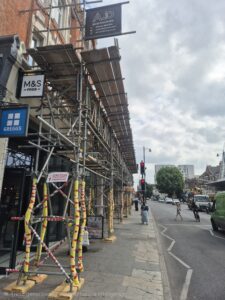
Westminster is one of London’s busiest boroughs and often has additional requirements for scaffolding erected on public highways.
Projects close to busy shopping streets, tourist areas or government buildings may require extra planning, pedestrian management and strict installation times.
Where access is limited, scaffold designs may also need engineering approval before installation.
Early planning is essential for projects within Westminster.
Parking Suspensions in London
Many homeowners do not realise that a scaffolding licence alone may not be enough.
If the scaffold vehicle requires access outside the property or standards need to be positioned within parking bays, the local authority may also require a parking suspension.
Parking suspensions are usually arranged separately and should be organised before installation day.
Failure to obtain the correct suspension can delay installation and increase costs.
Scaffold Design for London Project
Not every scaffold requires a bespoke engineering design.
Many straightforward domestic scaffolds can be erected in accordance with recognised industry guidance.
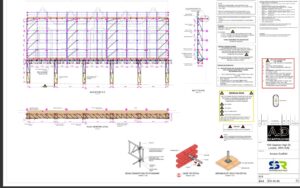
However, a scaffold design is commonly required where projects involve:
- Temporary roofs
- Large loading bays
- Cantilever scaffolds
- Bridges
- Unsupported sections
- Complex commercial structures
- High-risk locations
Professional scaffold designs ensure the structure has been properly assessed before installation.
Weekly Scaffold Inspections in London
Once scaffolding has been erected, regular inspections are essential.
In the UK, scaffolds should normally be inspected:
- Before first use
- Every seven days
- After severe weather
- After significant alterations
- Following any event that may affect stability
Inspection records should be retained throughout the project.
These inspections help identify any issues early and ensure the scaffold continues to provide a safe working platform.
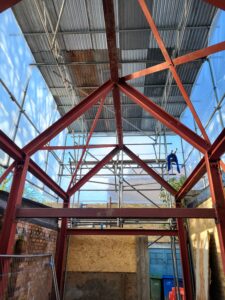
Temporary Roof Scaffolding London
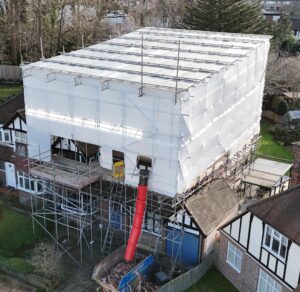
Temporary roof scaffolding is becoming increasingly popular across London.
It allows roofing contractors and builders to continue working during poor weather while protecting the property below.
Temporary roofs are commonly used for:
- Loft conversions
- Roof replacements
- Fire damage
- Structural alterations
- Large refurbishment projects
- Heritage buildings
Depending on the project, Monarflex sheeting or shrink-wrap systems may also be installed to provide additional weather protection.
Monarflex and Debris Netting
Many projects require additional protection for neighbouring properties and members of the public.
Monarflex sheeting helps reduce exposure to wind and rain while also improving dust containment.
Debris netting is commonly installed where there is a risk of small materials leaving the working platform.
The appropriate protection system will depend on the project, surrounding environment and client requirements.
Common Reasons Scaffold Licence Applications Are Delayed
Although many applications proceed smoothly, delays can occur.
Some of the most common reasons include:
- Incomplete application forms
- Incorrect site plans
- Missing insurance documents
- Design information not provided
- Parking suspensions not arranged
- Traffic management not approved
- High workload within the local authority
Submitting complete information at the beginning of the process can help minimise delays.
Planning Ahead Saves Time and Money
One of the best ways to keep a construction project running smoothly is to arrange scaffolding as early as possible.
Leaving scaffold design or licence applications until the last minute can delay roofers, builders, decorators and other trades.
Early planning allows sufficient time for:
- Site surveys
- Scaffold design
- Licence applications
- Parking suspensions
- Traffic management
- Material deliveries
A well-planned scaffold installation often reduces disruption and helps keep the overall project on schedule.
Why Professional Advice Matters
Every project is different.
A small domestic scaffold on private land may require very little planning, while a large commercial scaffold on a busy London street can involve multiple approvals before work begins.
Choosing an experienced scaffolding contractor means potential issues can often be identified before they become expensive problems.
At A.D. Scaffolding Ltd, we work closely with homeowners, builders, roofing contractors and commercial clients to provide safe, practical scaffolding solutions throughout South London.
Frequently Asked Questions
Do I always need a scaffolding licence?
No. If the scaffold is erected entirely on private land and does not encroach onto a public pavement or highway, a highway licence is often not required. However, every project should be assessed individually before work begins.
Who pays for the scaffolding licence?
In most domestic projects, the customer pays the council licence fee as part of the overall scaffold quotation. The scaffolding contractor usually prepares and submits the application.
How long can scaffolding remain in place?
This depends on the licence issued by the local authority and the agreed hire period. If work is delayed, an extension may be required.
Can scaffolding be erected over a neighbour’s property?
Sometimes, but only after careful assessment. Oversailing should always be minimised wherever possible and may require additional permissions depending on the circumstances.
Is scaffold design always required?
No.
Most straightforward domestic scaffolds can be erected using recognised industry guidance. More complex structures such as temporary roofs, cantilevers or large commercial scaffolds normally require an engineered scaffold design.
What happens if bad weather damages the scaffold?
The scaffold should be inspected before work continues.
Following high winds or severe weather, an additional inspection is recommended to confirm the structure remains safe.
Are weekly scaffold inspections included?
Inspection arrangements vary between contractors.
Always confirm whether weekly inspections are included within the quotation or charged separately.
Can I move scaffolding myself?
No.
Scaffolding should never be altered by anyone other than trained scaffolders.
Even removing a single component can seriously affect the stability of the structure.
How much notice should I give before installation?
The earlier, the better.
For projects requiring licences, scaffold design or parking suspensions, allowing additional time helps avoid unnecessary delays.
Preparing For Your Scaffold Installation
Before installation day it helps to:
✔ Clear vehicles from the working area.
✔ Inform neighbours if access may be affected.
✔ Remove garden furniture where necessary.
✔ Ensure access gates can be opened.
✔ Inform the scaffolding contractor of any underground cellars, basements or fragile surfaces.
✔ Advise if overhead cables or restricted access are present.
Good preparation allows the installation to proceed more efficiently.
Why Choose A.D. Scaffolding Ltd?
At A.D. Scaffolding Ltd we pride ourselves on providing safe, reliable and competitively priced scaffolding throughout South London.
Our experienced team works with:
- Homeowners
- Builders
- Roofing contractors
- Property developers
- Commercial clients
- Schools
- Local authorities
We provide:
- Residential scaffolding
- Commercial scaffolding
- Temporary roofs
- Loft conversion scaffolding
- Chimney scaffolding
- Scaffold design
- Weekly inspections
- Monarflex sheeting
- Debris netting
- Alarm systems
- Assistance with scaffold licence applications
Every project is carefully planned to provide safe access while minimising disruption to neighbouring properties and the public in London.
Areas We Cover
We regularly provide scaffolding throughout:
- Streatham
- Tooting
- Balham
- Clapham
- Wimbledon
- Mitcham
- Wandsworth
- Putney
- Battersea
- Fulham
- Chelsea
- Croydon
- Merton
- Kingston
- Richmond
- South West London
If your project is outside these areas, please contact us as we also undertake selected projects across Greater London.
Request A Free Quotation
Whether you’re planning a roof replacement, loft conversion, chimney repair, painting project or full property refurbishment, our experienced team is here to help.
We can advise on:
- Scaffold design
- Temporary roof systems
- Highway scaffold licences
- Commercial scaffolding
- Residential scaffolding
- Weekly inspections
- Safe access solutions
Contact A.D. Scaffolding Ltd today for a free, no-obligation quotation.
Final Thoughts
A professionally planned scaffold is about far more than simply providing access.
Correct planning, suitable design, appropriate licences and regular inspections all help keep projects running safely and efficiently.
Choosing an experienced scaffolding contractor from the outset can reduce delays, improve safety and give homeowners and builders confidence that the project is being managed correctly.
At A.D. Scaffolding Ltd we are committed to delivering high-quality scaffolding solutions across London, supported by professional advice, experienced scaffolders and outstanding customer service.